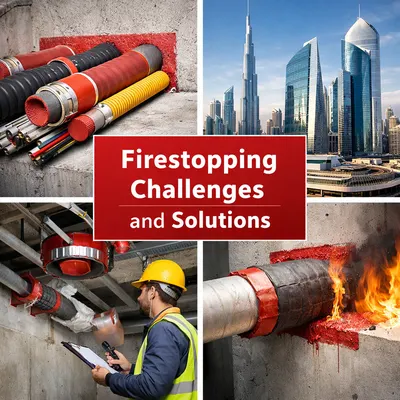
In the UAE’s rapidly evolving architectural landscape, buildings are no longer just functional structures — they are breathtaking feats of engineering, design, and technology. From towering skyscrapers on Sheikh Zayed Road to innovative mixed-use developments in Abu Dhabi and futuristic communities in Dubai, cutting-edge designs are redefining skylines. However, this complexity brings significant challenges for life-safety systems such as firestopping — crucial barriers that prevent the spread of fire, smoke, and toxic gases through penetrations in walls and floors.
At FSIME Construction LLC, we understand the importance of integrating reliable firestop solutions that match the sophistication of modern buildings while meeting stringent UAE safety standards. In this blog, we explore the key firestopping challenges in contemporary construction and practical solutions that ensure safety without compromising design intent.
Firestopping refers to the methods and materials used to seal openings and joints in fire-resistant walls and floors to restore their fire-resistance rating after penetrations for electrical, mechanical, and structural services. Without effective firestopping, fire and smoke can spread rapidly, putting lives and property at risk.
In cutting-edge designs, architects and engineers often push boundaries with open spaces, unconventional geometries, and complex service systems. Such innovations introduce multiple variables that traditional firestopping methods may struggle to address effectively.
Modern buildings incorporate dense networks of services — electrical conduits, plumbing, HVAC systems, data and communication cables — often intersecting at irregular and unpredictable angles. These complex penetration patterns challenge conventional firestop products, which are typically designed for simpler rectangular or circular openings.
Solution:
Use versatile firestop systems like firestop sealants, collars, wraps, and modular firestop blocks that adapt to irregular shapes and configurations. Products with proven field-tested performance enable installers to tailor firestop solutions on-site while maintaining fire resistance ratings.
Cutting-edge designs frequently employ advanced building materials such as composite panels, lightweight claddings, and curtain wall façades. While aesthetically stunning and high-performing in thermal efficiency, these materials may behave differently under fire conditions compared to traditional masonry or concrete.
Solution:
Conduct compatibility assessments between firestop products and innovative materials early in the design process. At FSIME Construction LLC, we collaborate with architects and engineers to select firestop systems engineered for compatibility with new construction materials, ensuring code compliance and optimal performance.
In ambitious projects, timelines are often compressed to meet market demands and investment deadlines. This pressure can lead to rushed firestopping installs or incomplete inspections — increasing risk and potentially jeopardizing certification.
Solution:
Implement proactive planning and rapid-cure firestop products that accelerate installation without sacrificing quality. Integrating firestop planning into the project schedule from the outset ensures that firestopping is not an afterthought but an integral part of construction sequencing.
In complex structures, many firestop assemblies are hidden behind walls, ceilings, and service shafts. This makes inspection and ongoing maintenance difficult yet essential for long-term safety certification.
Solution:
Adopt firestop solutions accompanied by documentation and labeling systems that provide clear, accessible records of installation. Regular scheduled inspections by certified technicians help detect degradation, especially in mechanical and electrical penetrations that may shift over time.
The UAE’s fire safety codes — aligned with international standards — are continuously evolving to reflect lessons learned from global incidents and advances in fire science. Designers and contractors need to stay updated on compliance requirements to avoid costly redesigns or regulatory delays.
Solution:
Partner with firestop experts like FSIME Construction LLC who maintain up-to-date knowledge of local regulations and industry best practices. Our team ensures that firestop designs and installations meet or exceed UAE fire safety codes, giving clients peace of mind and regulatory confidence.
Innovative architecture should not come at the expense of safety. In fact, sophisticated designs demand equally sophisticated firestop solutions. By understanding the unique challenges — from complex penetrations and new materials to tight timelines and compliance demands — builders can deploy the right firestop strategies that protect lives and assets.
At FSIME Construction LLC, we are proud to deliver industry-leading firestop products and expert services tailored for the UAE’s most ambitious projects. Whether you are developing a high-rise tower, luxury hotel, or mixed-use complex, we ensure that your firestop systems are robust, compliant, and seamlessly integrated into your vision.
 Call Back

 Call Us
+971 4 558 5075
 Email
Emailinfo@fsime.com
 +971 4 558 5075
 +971 4 558 5043
  info@fsime.com

 info@fsime.com